Germany: flag, capital & map
Get to know Germany, then put your memory to work.
Country facts
- Capital
- Berlin
- Region
- Europe
- Subregion
- Western Europe
- Population (2025, World Bank)
- 83,491,249
- Area
- 357,114 km²
- Languages (REST Countries)
- German
- Currency (CLDR, October 2026)
- Euro (EUR)
- Land neighbours
- Austria, Belgium, Czechia, Denmark, France, Luxembourg, Netherlands, Poland, Switzerland
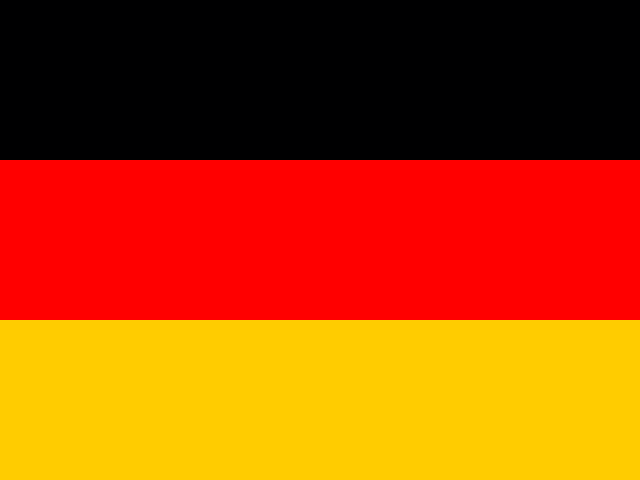
Berlin is Germany’s capital. The flag’s horizontal bands are black, red, and gold.
Dated population: World Bank; geographic facts: REST Countries; currencies: Unicode CLDR. Sources and dates →
Flag of Germany
The flag of Germany is composed of three equal horizontal bands of black, red and gold.
Where it is
Germany is grouped in Western Europe, within Roam’s Europe region. Its land-border list includes 9 countries in this atlas: Austria, Belgium, Czechia, Denmark, France, Luxembourg, Netherlands, Poland, Switzerland. The source classifies it as not landlocked.
Germany has a recorded area of 357,114 square kilometres. Among the 8 countries assigned to Western Europe in this dataset, it ranks 2 by area, from largest to smallest. France is immediately above it in that ordering, at 543,908 km². Netherlands is immediately below it, at 41,865 km². This comparison uses the source’s area figures and subregions, not a ranking of all territories.
The marker shows the atlas location. Small countries may be too small for an outline at this scale. Map boundaries are illustrative.
People, languages and currency
The World Bank records 83,491,249 people for Germany in 2025. This is the latest non-empty annual observation in Roam’s committed 2020–2025 download, rather than a live population counter. Dividing that population by the source area gives approximately 234 people per square kilometre. This calculated average does not describe how evenly people are distributed.
The language entries in the source are German. They describe the dataset’s listed languages, not every language spoken by residents. The currency listed for this date is Euro (EUR). Currency assignments are selected from Unicode CLDR’s date ranges for 23 October 2026; the three-letter codes identify currencies, not countries.
Test yourself
Cover the facts above and work through these five questions. Open each answer when you are ready to check it. You can use this section without JavaScript.
What is the capital of Germany?
Reveal answer
Berlin. Berlin is Germany’s capital. The flag’s horizontal bands are black, red, and gold.
Without looking at the image, how would you describe the flag of Germany?
Reveal answer
The flag of Germany is composed of three equal horizontal bands of black, red and gold.
Which land neighbours of Germany are included in this atlas?
Reveal answer
Austria, Belgium, Czechia, Denmark, France, Luxembourg, Netherlands, Poland, and Switzerland. The source classifies Germany as not landlocked.
Which languages does the source list for Germany?
Reveal answer
German. These are the source’s language entries, not a complete inventory of every language spoken in Germany.
Which currency codes are listed for Germany?
Reveal answer
Euro (EUR). These assignments use Unicode CLDR’s legal-tender date ranges for 23 October 2026.
Try it from memory
5 questions. Answers and feedback appear after each attempt. This short quiz does not change your daily score or saved progress.